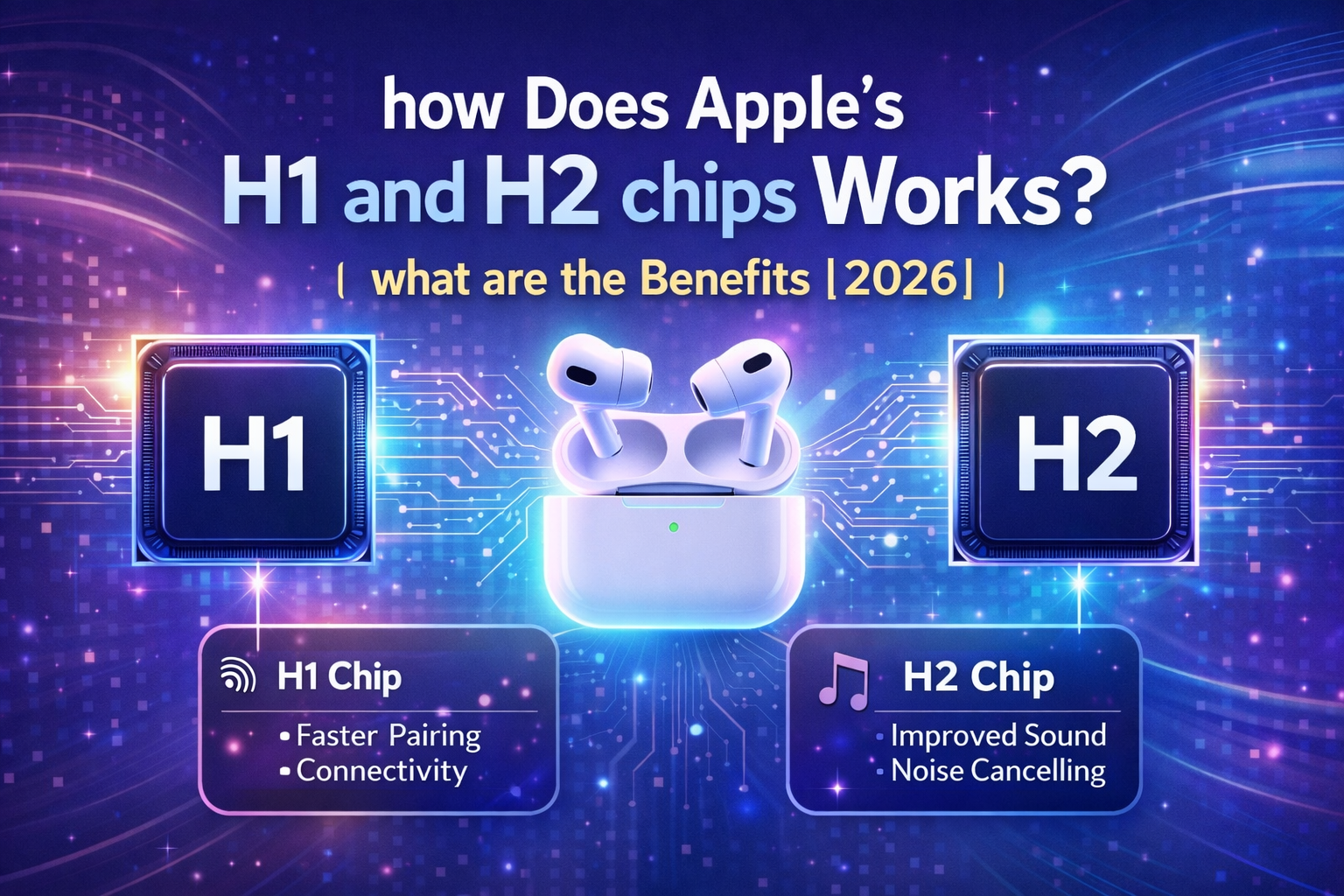
Apple’s H-series chips remain the “secret sauce” that makes AirPods feel more like a seamless experience than a standard Bluetooth accessory. While your phone handles the apps, these chips are dedicated entirely to the physics and mathematics of sound.
Here is the breakdown of the H1 and H2 chips, how they function, and the benefits they bring to your ears.
1. What Are the H1 and H2 Chips?
These are custom-designed Systems-in-Package (SiP). Unlike a traditional CPU, they don’t run an operating system; instead, they are highly optimized for low-latency audio, Bluetooth stability, and computational audio.
- Apple H1 (The Foundation): Introduced to replace the older W1 chip. It brought “Hey Siri” support and faster device switching.+1
- Apple H2 (The Powerhouse): Debuted with the AirPods Pro 2. It features nearly one billion transistors (roughly double the H1) and is built on a more efficient 7nm process.
2. How Do They Work?
The chips act as a “traffic controller” for your audio. Here is the technical magic happening inside:
Computational Audio
The H2 chip doesn’t just play music; it reconstructs it. It uses advanced algorithms to sample environmental noise up to 48,000 times per second. It then uses this data to:
- Inverse Waveforms: Create an “anti-noise” wave to cancel out background sounds (ANC).
- Adaptive EQ: Adjust the low and mid frequencies of the music in real-time based on how the earbuds fit in your specific ear canal.
Low-Latency Sync
Traditional Bluetooth has a delay between the screen and your ears. The H-series chips use a proprietary protocol that slashes this latency, which is why video and gaming feel perfectly synced on Apple devices.
3. Key Benefits: H1 vs. H2
| Feature | Apple H1 Chip | Apple H2 Chip |
| Noise Cancellation | Standard ANC | 2x More Effective ANC |
| Transparency | Standard Transparency | Adaptive Transparency (Dulls loud sirens/drills) |
| Bluetooth | Bluetooth 5.0 | Bluetooth 5.3 (More stable) |
| Siri | “Hey Siri” support | “Hey Siri” + Siri Interactions (Nod/Shake head) |
| Audio Quality | High Quality | Computational Audio (Better bass & clarity) |
| Battery Life | Standard Efficiency | Increased Efficiency (Better per-charge life) |
4. Unique Features Enabled by H2 in 2026
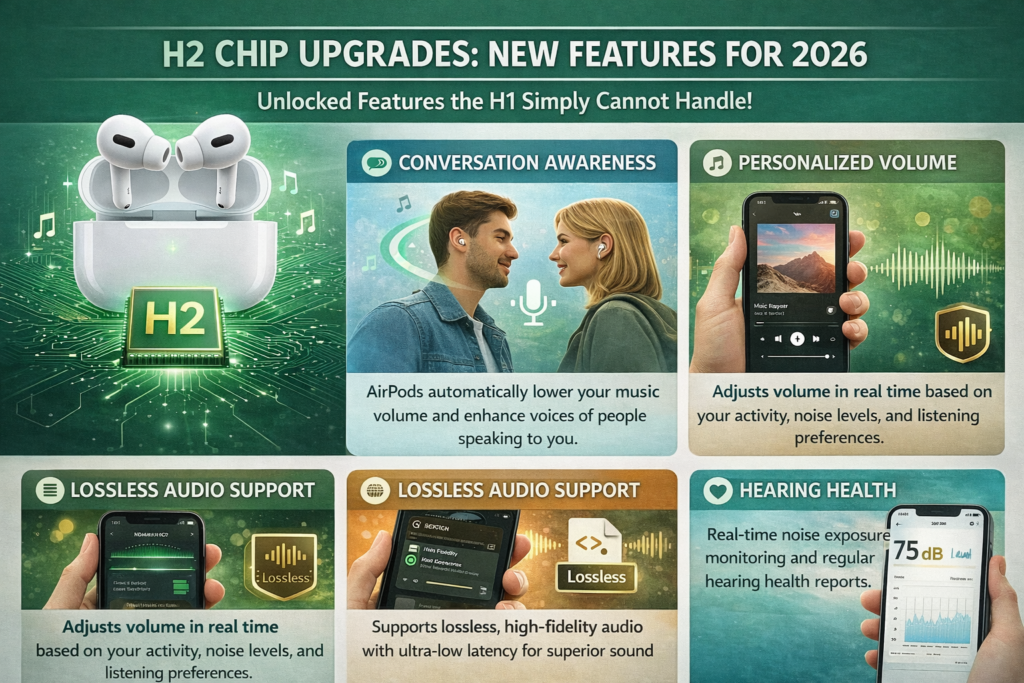
With the 2026 updates, the H2 chip has unlocked features that the H1 simply cannot handle due to processing limits:
- Conversation Awareness: The H2 chip detects when you start speaking. It automatically lowers your music volume and enhances the voices in front of you.
- Personalized Volume: Using machine learning, the H2 learns your volume preferences in different environments (e.g., louder on the subway, quieter in the office) and adjusts itself over time.
- Lossless Audio Support: When paired with the Apple Vision Pro, the H2 chip enables a 20-bit, 48 kHz lossless audio protocol with ultra-low latency.
- Hearing Health: The H2 powers the “Hearing Aid” and “Loud Sound Reduction” features, acting as a clinical-grade protector for your ears in loud environments.
5. Conclusion: Which One Do You Need?
The H1 chip is still great for casual listening and is found in the AirPods Max and older AirPods. However, the H2 chip is a massive leap for anyone who values silence (ANC) and “smart” features that adapt to your environment.
If you are a frequent traveler or work in a noisy office, the H2’s ability to sample noise 48k times per second makes it the clear winner for focus and audio fidelity.
- 10 Home Recording Studio Equipment [Updated List] 2026

- Why Do My AirPods Sound Muffled After Update? 5 Working Solution
- What Is cVc Noise Cancellation? Guide to Crystal Clear Calls [2026]

- How to Stop Bluetooth Interference From WiFi Routers | Most Common Issue
- How to Use Bluetooth to Connect Your Phone to Your Car | 3 Step Process
- How Does Apple’s H1 and H2 chips Works? what are the Benefits [2026]