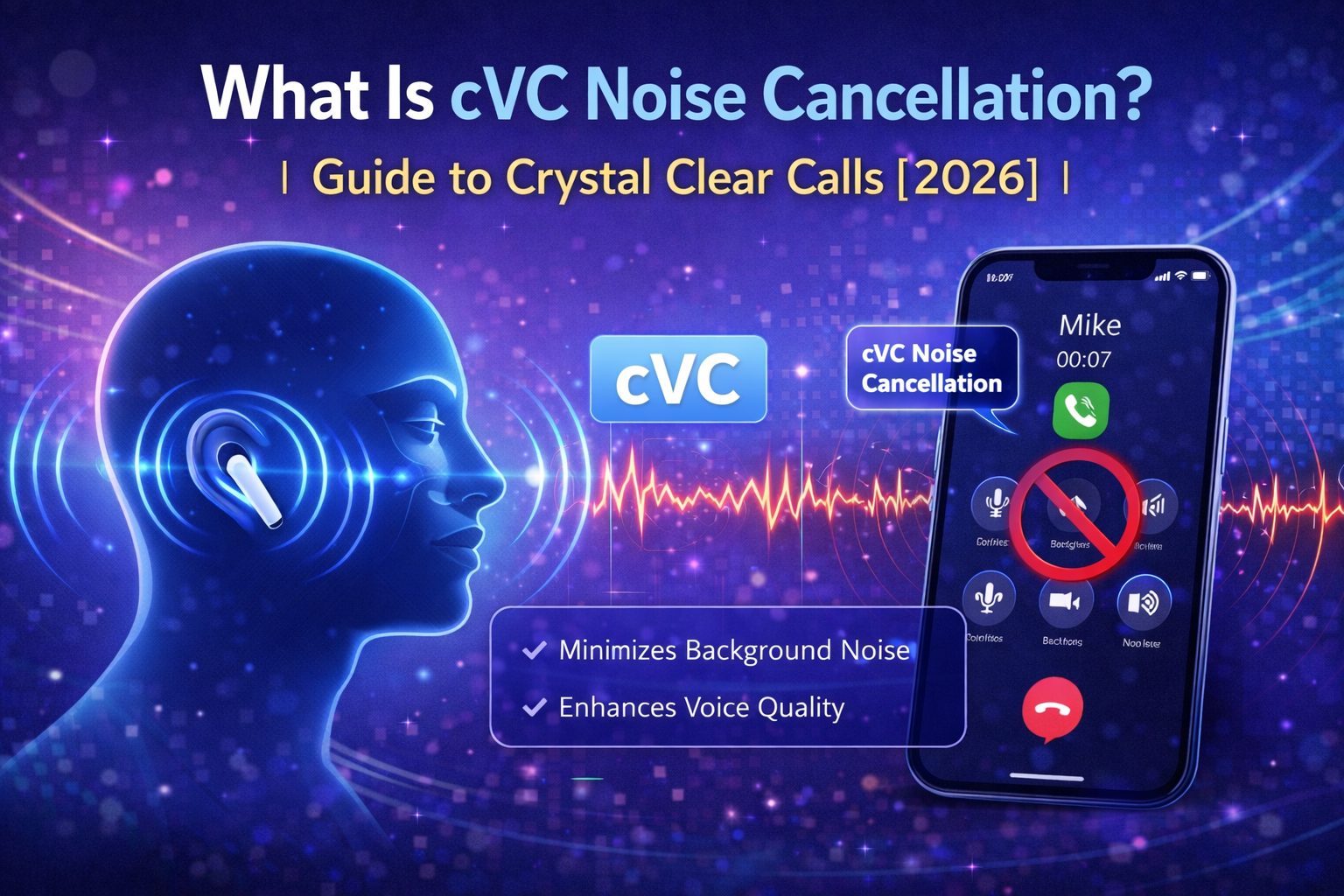
In an era of remote work and constant connectivity, we’ve all been there—taking an important client call while a leaf blower roars outside or a espresso machine screams in the background. You’re frantic, wondering, “Can they hear that?”
Enter cVc (Clear Voice Capture) technology.
If you’ve been shopping for headphones in 2026, you’ve likely seen “cVc 8.0” or “cVc Noise Cancellation” on the box. But what exactly is it? Is it the same as the “silence” you get on an airplane? Not quite.
Here is everything you need to know about cVc technology, how it differs from ANC, and why it’s the unsung hero of your professional life.
What is cVc Noise Cancellation?
cVc stands for Clear Voice Capture. Developed by Qualcomm, it is a sophisticated suite of algorithms designed to improve outgoing audio during voice calls.
Unlike other forms of noise cancellation that focus on what you hear, cVc is entirely about what the person on the other end of the line hears. It uses a combination of software and microphone hardware to isolate your voice from the chaotic environment surrounding you.
How It Works (The “Invisible Filter”)
When you speak into a cVc-enabled headset, the microphones pick up two things: your voice and the ambient noise. The cVc digital signal processor (DSP) then goes to work:
- Separation: It identifies the specific frequency of human speech.
- Suppression: It “mutes” the frequencies associated with non-human sounds (wind, traffic, chatter).
- Enhancement: It boosts your voice levels and removes echoes to ensure you sound natural, not robotic.
cVc vs. ANC: The Ultimate Comparison
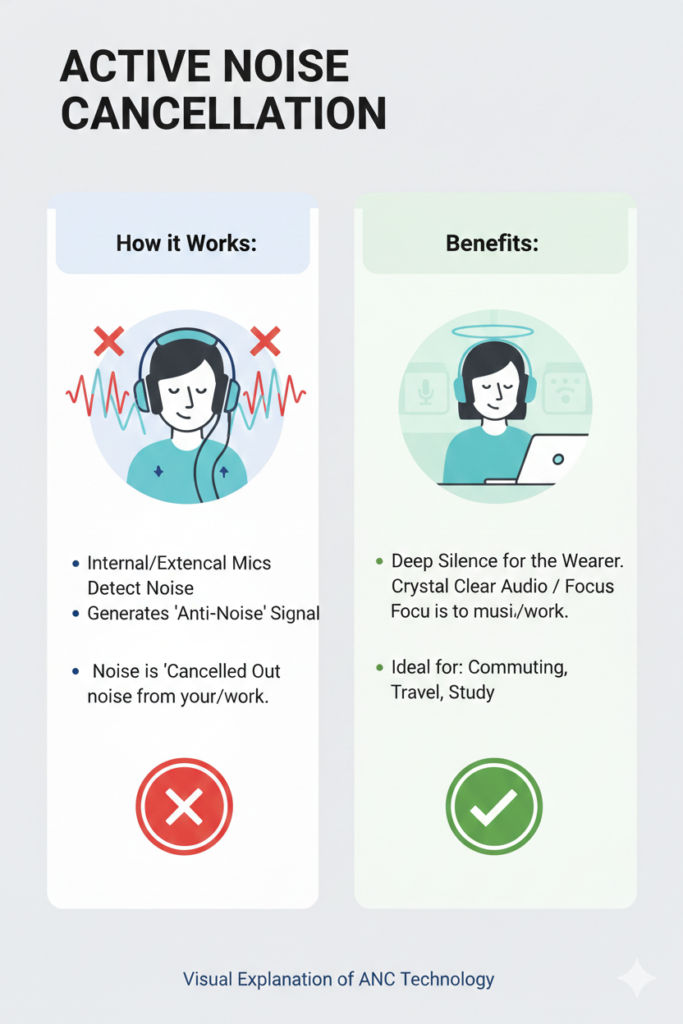
The biggest point of confusion for consumers is the difference between cVc and ANC (Active Noise Cancellation). While they both have “noise cancellation” in the name, they serve opposite purposes.
| Feature | cVc (Clear Voice Capture) | ANC (Active Noise Cancellation) |
| Primary Goal | Clearer calls for the listener. | Silence for the wearer. |
| Technology | Software algorithms & Mic arrays. | Hardware (Internal/External Mics). |
| Benefit | Professionalism on Zoom/Phone calls. | Focus while listening to music/work. |
| Impact | Filters background noise from your mic. | Filters background noise from your ears. |
| Best For | Business calls, Gaming, Outdoor calls. | Commuting, Air travel, Studying. |
Pro Tip: In 2026, the best premium earbuds usually feature both. They use ANC to give you peace and quiet, and cVc 8.0 to ensure your boss hears you clearly.
Why cVc 8.0 is the Gold Standard in 2026
As of 2026, cVc 8.0 is the most prevalent version found in high-end Bluetooth 5.4 and 6.0 devices. Compared to older versions (like 6.0), the 8.0 update offers:
- Dual-Mic Integration: It better coordinates multiple microphones to create a “beamforming” effect, narrowing the field of sound to just your mouth.
- Wind Noise Reduction: Advanced logic that detects and cancels the specific “whooshing” sound of wind, perfect for outdoor walkers.
- Packet Loss Concealment: If your Bluetooth connection flickers, cVc 8.0 fills in the tiny gaps to prevent your voice from sounding “choppy.”
- Echo Cancellation: Crucial for speakerphones and car kits where your own voice can loop back into the mic.
Real-World Use Cases: Where cVc Saves the Day
1. The “WFA” (Work From Anywhere) Professional
You’re working from a bustling Starbucks. The barista is shouting orders and the milk steamer is hissing. With cVc, your client hears a quiet room. It maintains your professional image regardless of your actual location.
2. The Commuter
Walking through a windy city center or standing near a subway platform? cVc suppresses the low-frequency rumble of the train and the sharp whistle of the wind, allowing you to have a normal conversation without shouting.
3. The Competitive Gamer
In the heat of a match, your teammates need clear callouts. cVc prevents your mechanical keyboard clicks and the sound of your PC fans from cluttering the voice chat.
Frequently Asked Questions (FAQ)
Does cVc affect battery life?
Very minimally. Because cVc is a software-based DSP (Digital Signal Processing) solution optimized by Qualcomm, it is far more energy-efficient than ANC, which requires constant physical power to move the speaker drivers.
Can I turn cVc on or off?
No. Unlike ANC, which usually has a toggle button, cVc is “always on” during calls. It is a fundamental part of the microphone’s processing path.
Does cVc improve music quality?
Technically, no. cVc is specifically for voice transmission. It does not change how your music sounds; however, many chips that support cVc also support aptX Lossless audio, which does improve music.
The Verdict: Do You Need It?
If you ever use your headphones for more than just listening to music—if you take meetings, call your family while walking, or play multiplayer games—cVc is non-negotiable. When browsing for your next pair of earbuds in 2026, look for Qualcomm cVc 8.0 in the specs. It is the difference between your caller saying “Wait, what did you say?” and “You sound like you’re standing right next to me.
- 10 Home Recording Studio Equipment [Updated List] 2026

- Why Do My AirPods Sound Muffled After Update? 5 Working Solution

- What Is cVc Noise Cancellation? Guide to Crystal Clear Calls [2026]
- How to Stop Bluetooth Interference From WiFi Routers | Most Common Issue
- How to Use Bluetooth to Connect Your Phone to Your Car | 3 Step Process

- How Does Apple’s H1 and H2 chips Works? what are the Benefits [2026]